Using OHA Drinking Water Data Online to Check Public Systems
Trying to confirm who supplies your tap water or whether a public system reports fluoride can be harder than expected: provider names and service areas do not always match a street address. Oregon residents can use Oregon Drinking Water Services data online to check fluoride information. Start by identifying your actual water provider, then treat online results as a starting point for questions—not a substitute for a system’s current notices or reports.
Start by identifying your water provider
An online search is only useful if you select the system that serves your home. The name on a bill, a neighborhood name, and the formal name used in a state record may differ. That can make a correct system hard to recognize, especially if you recently moved or live in a building where water service is managed by a landlord or property manager.
Check the source of your water
If you receive a water bill, look for the provider or system name on it. A bill may be issued by a city, district, or another organization, and the name shown there is a practical place to begin. If water charges are included in rent or a homeowners’ association payment, ask the landlord, property manager, or association which system supplies the building.
You can also use Reading Your Oregon Water Bill: Finding System Contact and PWS Info for clues about where system information may appear. If the provider name is unfamiliar or seems to describe a nearby community rather than your exact address, confirm the match before interpreting results.
Confirm the service area rather than guessing from a nearby town
A home’s mailing address does not always tell you who supplies its water. A property outside a city boundary may still receive water from a public system, while homes close together may connect to different providers. Avoid choosing a record only because its system name sounds familiar or its location seems nearby.
The Using the Oregon Public Water Systems Map to Locate Your Provider resource can help you investigate which system serves an address. Once you have a likely match, compare the provider name with a bill or ask the provider to confirm that it serves your property. If the online record and your bill use different names, do not assume they refer to the same system until you have checked.
Establish whether the home uses public water or a private well
The online information discussed here concerns public water systems. A home supplied by a private well has a different path for checking water quality; a nearby public-system record should not be used as a stand-in for a well test.
If you are unsure whether a rental or recently purchased home uses public water, ask the property owner or manager and check available property documents. For a private well, see Is Oregon Private Well Water Safe to Drink? How Testing Confirms It. Knowing the source first helps prevent a common mistake: reviewing a system’s information that does not apply to your tap.
Find fluoride information in Oregon Drinking Water Services data
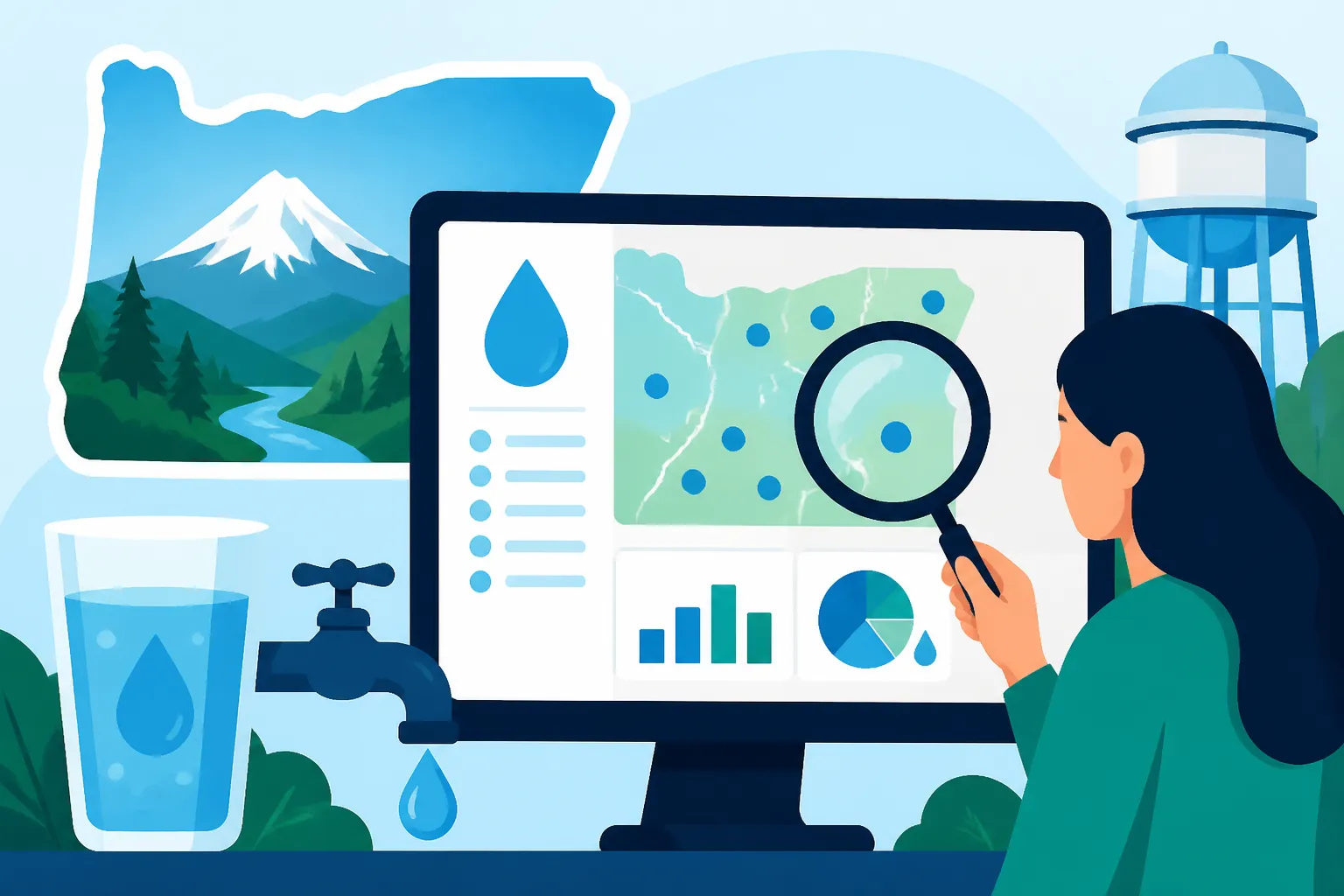
According to the Oregon Health Authority, residents can Visit Oregon Drinking Water Services data online to find out whether their drinking water contains fluoride. The key practical step is to search for the system that actually serves your home, rather than relying on a general claim about a city or region.
Search with the system name you have confirmed
Begin with the provider name from your bill or a confirmation from the provider. If you cannot find it, try the formal name the provider gives you rather than using only a neighborhood or city name. When a search returns several possible records, pause and check the system identity before drawing a conclusion about fluoride.
An online record is most helpful when you can confidently connect it to your address. If you cannot make that connection from the information available, contact the provider through its official website and ask which system supplies your property. You can also ask where the provider directs customers to check fluoride information.
Read the result as system information, not a guarantee about every tap
A system-level result is useful for understanding what the provider reports about its drinking water. It does not, by itself, answer every question about the water at an individual faucet. Home plumbing, a building’s internal pipes, and a point-of-use treatment device are separate considerations from the public system’s information.
If your concern is specifically about fluoride, distinguish between whether a system reports fluoride and what that result means for your household. Does Fluoride Occur Naturally in Oregon Drinking Water? explains why fluoride can be present in water for different reasons. Oregon Systems That Add Fluoride or Buy Fluoridated Water is also relevant when you want to understand the difference between adding fluoride and receiving water that contains it from another source.
If you need to make a decision related to health, ask a medical professional or your local health department. Online system information is a useful starting point, but it is not individual medical advice.
Compare the online record with the provider’s own information
If the result is unclear, compare it with the provider’s current materials or ask the provider to confirm what applies to your service area. A broad statement about a town or a neighboring community may not describe every water system serving that area.
For more context on the documents water providers make available, see Reading an Oregon Consumer Confidence Report: A Homeowner Guide and How to Access Your Oregon Public Water System Annual Report. These reports can help you understand system information beyond a single search result. They are especially useful when you want a more complete overview or need to check the wording and context behind a result.
Understand what online data can—and cannot—tell you
A data page can be a helpful way to check information, but it is easy to ask more of it than it was designed to answer. Before acting on a result, consider which question you are trying to resolve: whether a system reports fluoride, whether a current advisory applies, what a report says about water quality, or whether a household faucet needs testing.
A fluoride lookup is not the same as a complete water-quality review
The Oregon Health Authority identifies checking whether drinking water contains fluoride as a reason for residents to use Oregon Drinking Water Services data online. That does not mean a fluoride result answers every question about a public system or a home’s plumbing.
If your concern is a different contaminant or a change in taste, odor, or appearance, look for information that addresses that particular issue. A fluoride result cannot establish the presence or absence of another substance. For a broader view of a provider’s reported water quality, review its consumer confidence report or annual report, and ask the provider how to interpret a specific entry.
For a question about a possible active notice, use the relevant notice information rather than treating a routine system record as confirmation that no advisory exists. Oregon Drinking Water Advisories Map: Checking Active Notices can help you approach that separate question.
Public-system information does not diagnose household plumbing
Water quality at the point where a provider supplies water and water at a household tap are related but not identical questions. Pipes and fixtures inside a building can affect what comes out of a particular faucet. A general system record should not be used to rule out an issue in older plumbing or to diagnose a change that occurs only at one tap.
If your concern involves lead, for example, a provider’s general water data may not tell you what is happening in your specific plumbing. Guide to Testing Oregon Tap Water for Lead and Copper explains why a household sampling question differs from a system-wide lookup. For a home with a private well, use well-specific testing information rather than a public-system record.
Watch for differences in names, locations, and reporting context
A record may be difficult to interpret if its formal system name differs from the name you use in daily life. It may also be unclear whether the record applies to an entire provider, a particular service area, or a specific reporting context. Do not fill in those gaps by guessing.
When in doubt, write down the system name and the wording you see, then ask the provider to explain whether it applies to your address. If you are reading a report, note the subject of the entry and the context around it instead of relying on a single isolated phrase. A clear question is often more useful than repeatedly searching with different spellings.
Keep the public search separate from the laboratory reporting portal
The Compliance Monitoring Data Portal has a different purpose from a resident’s search for information about a water provider. According to the Oregon Health Authority, it is An application allowing certified laboratories to report data electronically to the Oregon Health Authority (OHA). The agency also states that certified laboratories can use the portal to report data electronically to the Oregon Health Authority.
That description is important because a portal associated with drinking-water data may sound like a consumer lookup tool. The stated purpose of the Compliance Monitoring Data Portal is laboratory reporting. Residents checking a public system’s fluoride information should use Oregon Drinking Water Services data online, as directed by the Oregon Health Authority, rather than assuming the laboratory portal is the right place to search.
If you encounter a page that asks for laboratory reporting information or appears intended for certified laboratories, it may not be the resident-facing information you need. Return to the Oregon Drinking Water Services data resource or ask the provider where customers should look. Do not submit data or forms through a reporting system unless you are the intended user and have been directed to do so.
This distinction also helps when searching online: similar terms such as “drinking water data” or “compliance data” can lead to resources with different audiences. Check the agency’s description of a tool before using it, and match the tool to your task.
What to do when a result is missing or confusing
Not finding a clear result does not, on its own, tell you whether a system has a particular water characteristic. It may mean you are searching under the wrong name, looking at a system that does not serve your address, or using a resource that does not answer your question. Work through the uncertainty before reaching a conclusion.
Confirm the name and the service connection
Compare the name in your search with the name on a bill or information from the landlord or provider. If those names differ, ask the provider whether they refer to the same system and whether it serves your property. If you recently moved, use the address and service details from your current account rather than relying on an old bill or previous home.
When a property has a shared or managed water arrangement, ask who handles water service and which public system supplies the building. A landlord’s statement that water is “city water” may not be enough to identify the formal system record. Request the provider name or a direct pointer to the provider’s official information.
Ask a focused question
If you contact a provider, make the question specific. For example, ask whether the system serving your address is the one shown in the record, whether the information refers to fluoride, or where to find the latest report relevant to your concern. A focused question makes it easier to distinguish an identity issue from a question about what the data means.
Use the provider’s official website to find current contact details. This independent guide is not a water utility or government agency, and the provider or the Oregon Health Authority is the appropriate place to confirm current system information.
Choose the right next step for the issue
For a general system overview, check the provider’s report. For an active notice, check advisory information. For a concern tied to one faucet or to household plumbing, consider whether a home-specific test is needed. For a private well, use a well testing resource. These are different questions, so the most useful next step depends on what prompted your search.
A simple comparison can keep the task on track:
| Your question | Best next step |
|---|---|
| Which public system serves my address? | Confirm the provider using a bill, property manager, or the provider’s official information. |
| Does the water system serving me report fluoride? | Use Oregon Drinking Water Services data online and verify the system match. |
| What does the provider report more broadly? | Read the provider’s consumer confidence report or annual water report. |
| Is there an active drinking-water advisory? | Check current advisory information rather than relying on a routine system lookup. |
| Is a particular household faucet affected? | Consider a home-specific test or ask a qualified professional about the plumbing concern. |
| Does a public-system record apply to my private well? | No; use well-specific information and testing guidance. |
Frequently Asked Questions
Can Oregon residents use OHA data to check fluoride?
Yes. According to the Oregon Health Authority, residents can Visit Oregon Drinking Water Services data online to find out whether their drinking water contains fluoride. Confirm that the record is for the system serving your address.
Is the Compliance Monitoring Data Portal the consumer lookup tool?
The Oregon Health Authority describes that portal as an application allowing certified laboratories to report data electronically to the Oregon Health Authority (OHA). Residents looking for system information should use the Oregon Drinking Water Services data resource identified by the agency.
What if I cannot tell which system serves my home?
Check your water bill or ask your landlord, property manager, or provider to identify the system. If the name in a record does not match the name you know, ask the provider to confirm whether it applies to your address before interpreting the result.
Does a public-system record tell me what is happening at my faucet?
Not necessarily. A system-level result does not resolve every household plumbing or faucet-specific question. If your concern is tied to a particular tap, seek advice about appropriate home testing rather than treating a general system record as a household test.
Sources
- Oregon Health Authority — Oregon Health Authority: Benefits of Fluoride: Oral Health: State of Oregon (checked November 14, 2026)
- Oregon Health Authority — Oregon Health Authority: Monitoring and Reporting: Monitoring and Reporting: State of Oregon (checked November 14, 2026)
Disclaimer
This article is for general informational purposes only and does not constitute professional advice. Laws, prices and regulations vary by location and change over time. Consult a qualified professional for guidance on your specific situation. Oregon Water Guide is not a government agency or water utility and is not affiliated with any public water system.